
What is OTN? A Complete Guide to the Optical Transport Network Layer
Global data traffic continues to grow at an exponential pace, driven by cloud adoption, data centers, 5G, video streaming, and AI workloads. To support these bandwidth-hungry applications, networks must be scalable, transparent, and efficient, without introducing complexity or high costs.
This is where the Optical Transport Network (OTN) plays a critical role. It is typically deployed over Dense Wavelength Division Multiplexing (DWDM) but can also operate as a standalone digital transport layer. As a standardized Layer-1 digital transport technology, OTN unifies different types of services, legacy and modern, into a single, robust optical layer. It enables service providers, enterprises, and data centers to simplify operations, improve network visibility, and scale bandwidth cost-effectively.
What is OTN?
The Optical Transport Network (OTN) is an international standard defined by the ITU-T (International Telecommunication Union – Telecommunication Standardization Sector). It provides a digital wrapper that allows multiple client signals to be transported over optical fiber while ensuring error correction, monitoring, and management.
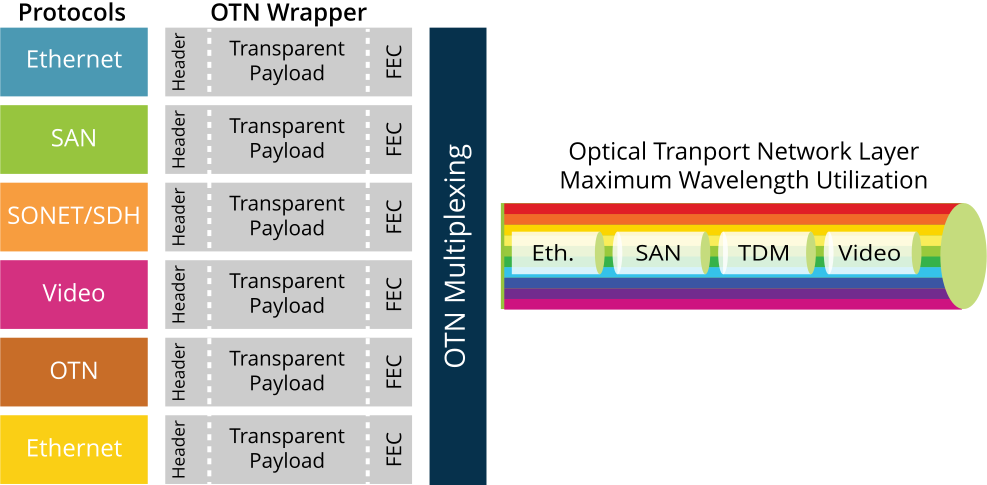
OTN introduces a high layer of intelligence, encapsulating client services into OTN containers (OTUs), adding Forward Error Correction (FEC), and integrating Operations, Administration, Maintenance (OAM) features for fault management, monitoring, and provisioning, with higher-level control frameworks typically layered on top.
Services Mapped Over the OTN Layer
OTN is designed for service convergence. Instead of building separate infrastructures for different protocols, service providers can map all of the following into one OTN-based network:
- Ethernet (LAN traffic) – enterprise and data center networking
- Fibre Channel (SAN traffic) – storage area networks and disaster recovery
- SONET/SDH – legacy TDM-based transport still used in some carrier environments
- Video and Voice Services – broadcast, OTT, and real-time communications
- Emerging Protocols – AI interconnect (such as RoCE), cloud data workloads, and 5G backhaul
This flexibility allows organizations to future-proof their networks while supporting existing traffic requirements.
Advantages of OTN
1. Extended Reach with Forward Error Correction (FEC)
OTN’s built-in FEC significantly extends optical reach, reducing regeneration needs when combined with DWDM amplifiers and coherent optics.
- This reduces the number of regeneration points.
- Lowers both capital expenditure (CapEx) and operational expenditure (OpEx).
- Enables long-haul transport across metro and backbone networks.

2. Simplified Performance Monitoring
With OTN, performance monitoring is unified at the transport layer:
- Supporting all service types regardless of payload (Ethernet, Fibre Channel, SONET/SDH).
- Providing consistent end-to-end monitoring and alarms.
- Simplifying troubleshooting in multi-vendor networks.
This reduces operational bottlenecks and minimizes SLA risks for service providers.
3. Built-in OAM&P for Network Control
The OTN layer includes OAM&P features such as:
- Remote management and diagnostics
- End-to-end visibility
- Automated provisioning and service activation
This allows engineering and operations teams to manage large optical networks efficiently, without relying on multiple vendor-specific systems.
4. Cost Efficiency and Vendor Neutrality
By converging multiple protocols into one optical layer, OTN reduces the need for dedicated network infrastructure. Combined with open, vendor-neutral design, this prevents lock-in and lowers the Total Cost of Ownership (TCO).
5. Scalability for Future Workloads
OTN supports line rates of 10G (OTU2), 100G (OTU4), 200G (OTUC2), and 400G (OTUC4), with clear upgrade paths to 800G and beyond. This scalability makes it the ideal backbone for:
- AI-driven data centers
- GPUaaS providers
- Cloud interconnects
- High-bandwidth enterprise workloads
OTN in Modern Optical Networks
The synergy of OTN + DWDM forms the foundation of modern optical networking. Together they provide:
- Transparency: Multiple services coexist without interference.
- High Bandwidth: Support for terabit-scale traffic.
- Reliability: FEC and OAM&P ensure stable performance.
- Flexibility: Works across metro, long-haul, and subsea networks.
- Control: Enables service providers to maintain visibility and avoid vendor lock-in.
This makes OTN a cornerstone technology for service providers, system integrators, and enterprises across industries like finance, healthcare, manufacturing, and government.
FAQs About OTN
What does OTN stand for?
OTN stands for Optical Transport Network. It is a standardized digital transport layer for optical networking that provides service encapsulation, error correction, and management.
How is OTN different from DWDM?
In optical networks, DWDM provides the optical multiplexing of wavelengths, and OTN provides the digital Layer 1 multiplexing and management structure on top of those wavelengths.
- DWDM multiplexes multiple wavelengths over a single fiber.
- OTN adds intelligence on top by encapsulating client signals, ensuring error correction (FEC), and enabling monitoring (OAM&P).
What are OTN containers (OTUs)?
Client signals are mapped into uplinks of OTN containers (OTUs). This standardization ensures scalability and interoperability across different vendors.
Examples include:
- OTU2 = 10G
- OTU4 = 100G
- OTUC2 = 200G
- OTUC4 = 400G
Why is Forward Error Correction (FEC) critical in OTN?
FEC improves signal quality by correcting bit errors, enabling to extend the reach of optical links by hundreds of kilometers without regeneration. This reduces costs and improves reliability.
Can OTN support modern workloads such as AI and cloud services?
Yes. OTN is designed to handle high-bandwidth, low-latency traffic, making it ideal for data centers, GPU clusters, AI training models, and 5G networks.
How does OTN simplify network operations?
Through built-in OAM&P, OTN provides remote monitoring, automated provisioning, and unified performance data, allowing faster troubleshooting and lower operational costs.
Who uses OTN today?
- Tier 2/3 carriers and service providers needing efficient multi-service transport
- Data centers requiring scalable interconnects
- Enterprises in finance, healthcare, manufacturing with high-security networking needs
- System integrators and AI infrastructure providers seeking future-ready solutions