
DWDM Technology Explained: High-Capacity Optical Networking
What Is DWDM?
Dense Wavelength Division Multiplexing (DWDM) is an advanced fiber-optic transmission technology that enables the simultaneous transport of multiple data streams over a single optical fiber. Each data stream is carried on a unique wavelength (or channel), dramatically increasing fiber capacity without the need for additional fiber cables.
DWDM is the foundation of modern long-haul, metro, and data center interconnect networks, supporting the massive growth of cloud services, video streaming, and AI-driven workloads.

How DWDM Works
DWDM operates by combining (multiplexing) several wavelengths into one optical signal for transmission and then separating them (demultiplexing) at the receiving end. Each wavelength carries independent data, which may include Ethernet, OTN, Fibre Channel, or SDH/SONET services.
Key elements of a DWDM system include:
- Transponders or muxponders to map client services onto wavelengths.
- Optical amplifiers to extend transmission reach over hundreds or thousands of kilometers.
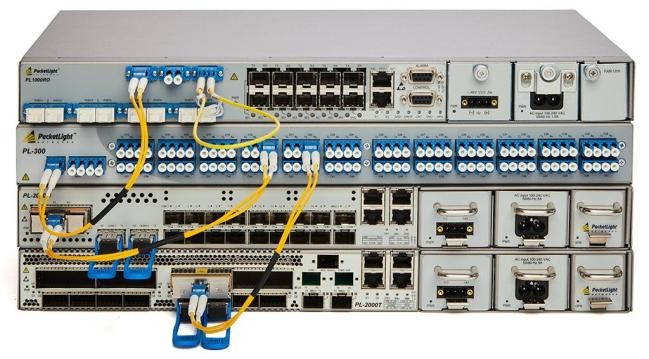
- ROADMs (Reconfigurable Optical Add-Drop Multiplexers) to dynamically route and manage wavelengths in the network.
Advantages of DWDM Technology
- Massive Bandwidth Scalability: DWDM systems can transport up to 96 wavelengths per fiber, each supporting speeds from 10G to 400G and beyond.
- Cost Efficiency: Maximizes existing fiber infrastructure without the expense of laying new cables.
- Protocol Transparency: Supports multiple services simultaneously, including Ethernet, OTN, Fibre Channel, and video transport.
- Ultra-Long-Haul Performance: Enables long distance transmission with optical amplification and forward error correction (FEC).
- Flexibility: Compatible with open line systems, enabling multi-vendor integration and vendor-neutral deployments.
Applications of DWDM
DWDM is deployed across a wide range of use cases, including:
- Data Center Interconnect (DCI): Linking enterprise and cloud data centers with secure, high-capacity connections.
- Telecom Carrier Networks: Scaling core and metro networks to support 5G, broadband, and enterprise services.
- AI and HPC Workloads: Delivering the low-latency, high-throughput connectivity required for distributed training and inference.
- Enterprise Private Networks: Enabling secure, scalable backbones for finance, healthcare, and manufacturing organizations.
Challenges of DWDM Deployment
DWDM delivers massive capacity and flexibility and integration requires precise optical engineering. Operators must ensure signal quality, manage optical impairments, and implement monitoring for service-level assurance. Automation and advanced network management platforms simplify deployment and reduce operational complexity.
FAQ: DWDM in Optical Networking
1. How does DWDM differ from CWDM?
CWDM (Coarse Wavelength Division Multiplexing) uses fewer, more widely spaced channels and is best suited for shorter distances. DWDM packs more channels into the same fiber with tighter spacing, supporting higher capacity and longer-haul transmission.
2. What services can run over DWDM networks?
DWDM is protocol-agnostic, supporting Ethernet, OTN, Fibre Channel, SONET/SDH, and video services simultaneously over a single optical infrastructure.
3. Is DWDM future-proof?
Yes. DWDM systems are designed to scale, supporting upgrades from 10G to 400G and 800G wavelengths, ensuring long-term investment protection.
4. How far can DWDM transmit data?
With the use of optical amplifiers and dispersion compensation, DWDM networks can span thousands of kilometers without electrical regeneration, making them ideal for long-haul and submarine networks.
5. Why is DWDM important for data centers?
Data centers require ultra-high capacity and low latency to handle massive workloads. DWDM provides the scalability and flexibility to interconnect facilities efficiently while ensuring service reliability.